
Floyd, Sergeant Charles
Sergeant Charles Floyd is best known as the only member of the crew to die during the Lewis and Clark Expedition, and the first United States soldier to die west of the Mississippi.
Floyd was born in Kentucky around 1782. In 1803, he joined the Corps of Discovery, the military expedition that would explore the Louisiana Territory.
The night of August 19th 1804, as the explorers reached the area just south of Sioux City, Floyd became seriously ill with "bilous cholic". Although expedition leaders did everything they could to help the young soldier, Floyd became weaker. "At the last," he told Captain Clark, "I'm going away and I want you to write me a letter." He died sometime after 2:00 in the afternoon on Monday, August 20, 1804.
Captain Clark read the funeral service for Charles Floyd and noted in his journal: "We buried him on the top of the bluff 1/2 Mile below a Small river to which we Gave his name, he was buried with the Honors of War, much lamented." Patrick Gass, another member of the expedition noted that they buried him "in the most decent manner our circumstances would admit." His grave was marked with a cedar post with the inscription "Sergt. C. Floyd died here 20th of August 1804."
It is now believed that what was described as "bilous colic" was likely appendicitis. At that time in history, there was no cure for that disorder, and Floyd would likely have died even in the best hospital.
Two years later, as the expedition returned from the mouth of the Columbia River, the men visited the site of Floyd's Grave. They found it had been disturbed, perhaps by animals. They restored the grave and replaced the fallen cedar marker.

In the years that followed, Floyd's Bluff and the cedar post became a landmark for white travelers in the area. The famous painter George Catlin later painted the gravesite while passing through the area in 1832.
Over the years, the Missouri River eroded Floyd's Bluff, and rain eroded the end of the grave, washing away the cedar post. In 1857, concerned citizens of the little town of Sioux City recovered what remains they could find and placed them in a walnut coffin. They buried the coffin 600 feet back from the river and remarked the grave.
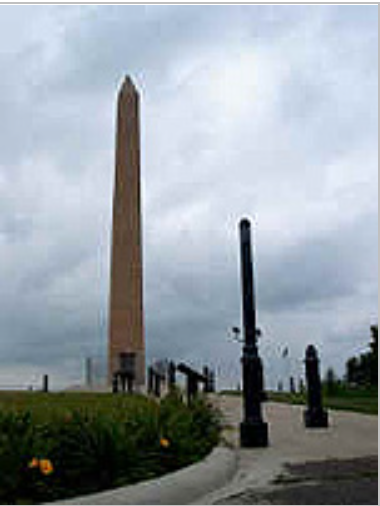
Floyd MonumentIn 1894, Floyd's Journals of the Lewis and Clark Expedition were rediscovered, renewing interest in the young soldier and his gravesite. However, for nearly forty years cattle had trampled the grave and souvenir hunters had carved away the wooden markers. It took considerable searching, but the grave was rediscovered on Memorial Day 1895.
His remains were placed in two earthenware urns and reburied again on August 20, 1895. The citizens held a special re-interment service. This time a marble slab, four feet by eight, was placed over the grave. The Floyd Memorial Association was also formed in 1895 for the purpose of honoring Sergeant Floyd in a more fitting way, with a permanent monument in his memory.

